
%2520(3).jpg&w=3840&q=75)


The Only Packing List You Need for a 17-Day Europe Trip
What if you could pack for 17 days in Europe... in one bag? This guide shows you how pros travel light without missing a thing.
 by Amira Bula
You're gliding off a train in Prague with just one perfectly packed bag slung over your shoulder, while other travelers struggle with oversized suitcases on cobblestone streets.
That could be you on your 17-day European adventure – and it's easier than you think with the right Europe trip packing list.
After years of watching travelers make the same packing mistakes (and making plenty myself), we've learned that the secret to a great European trip isn't bringing everything you “might need” – it's bringing what you will need.
Let us walk you through how to pack smart for over two weeks of European summer bliss without breaking your back or your budget.
This guide serves as your essential Europe trip packing list whether you're planning a shorter getaway or an extended adventure.
Why One Bag Changes Everything

The golden rule for European travel is simple: pack as light as humanly possible.
Think one carry-on sized bag – ideally a comfortable backpack – and maybe a small daypack.
European cities weren't built with rolling suitcases in mind. Picture yourself dragging a heavy bag up the stairs of a Paris Metro station or bouncing it across Rome's ancient cobblestones.
Not exactly the romantic European experience you had in mind, right?
Going light saves you money too. Budget airlines like Ryanair and EasyJet have strict size and weight limits for carry-ons.
Stick to their rules with one bag, and you won't pay extra fees. Plus, you can skip the luggage carousel entirely and hop on public transit instead of expensive taxis – try doing that with three massive suitcases.
Here's the truth most people don't want to hear: you probably don't need that third pair of cute sandals or the "just in case" outfit for a fancy dinner that might never happen.
Experienced travelers consistently say their biggest regret is overpacking. Every extra item is weight you'll carry for miles.
And here's the beautiful part – if you actually need something (like warmer clothes for an unexpectedly chilly Berlin evening), you can buy it.
Europe has stores. Lots of them. Leaving space in your bag isn't just smart, it's necessary for souvenirs and gives you flexibility as you go.
Building Your 17-Day Capsule Wardrobe
The secret to not overpacking clothes is creating a capsule wardrobe – a small collection of mix-and-match pieces that work together.
For 17 days, you'll do laundry at least 3 times, so you really only need about a week's worth of outfits. This same principle applies whether you're packing for Europe trip adventures lasting two weeks or even longer journeys.
Start with 3-4 tops, 2-3 bottoms, and a couple of lightweight dresses or nicer shirts.
Add one light jacket or hoodie for cooler evenings. That's it. It sounds minimal, but with smart mixing and matching, you'll have plenty of outfit combinations.
The trick is choosing versatile pieces in neutral or complementary colors that can be dressed up or down.
Comfort is king when you'll be walking 15,000+ steps a day.
Pack your favorite worn-in t-shirts, breezy shorts or skirts, and maybe one pair of lightweight pants for churches or cooler evenings.
Skip the jeans if you can. They're bulky, take forever to dry, and can be sweltering in July heat.
Swap them for breathable linen pants or lightweight travel pants that pack small and dry quickly.
Remember, you're packing for vacation life, not work life.
For daytime exploring and casual dinners, your normal summer clothes are perfect. Don't overthink trying to dress "European" – in summer, locals definitely wear t-shirts, shorts, and sundresses too.
Fabric choices matter. Look for materials that survive multiple wears without getting smelly.
Merino wool might sound crazy for summer, but it's actually breathable and naturally odor-resistant.
You can wear a merino t-shirt 2-3 times before it needs washing – a game-changer for light packing.
For other pieces, choose quick-dry fabrics. Most synthetics, thin cotton, and linen work well.
Nothing should take more than overnight to air-dry. Heavy cotton hoodies and thick denim can take days to dry and get mildewy – avoid them.
Pack about 5-7 pairs of underwear and socks in quick-dry or merino fabrics. You can wash a few in the sink whenever you have downtime.
Smart Shoe Strategy
Shoes are often the heaviest, bulkiest items in your bag, so be strategic. Bring a maximum of two pairs: one on your feet, one in your bag.
For summer with lots of walking, We recommend comfortable walking shoes and lighter shoes like sandals.
Your walking shoes might be well-broken-in sneakers, travel flats, or hiking shoes – whatever fits your style and can handle cobblestones and long days.
Pick a neutral color that goes with most outfits. The key is that they're broken in and supportive. Don't debut brand new shoes in Europe unless blisters sound fun.
Your second pair can be sandals, flip-flops, or lightweight slip-ons. Having something that lets your feet breathe is lovely in summer heat.
Flip-flops work for beaches and hostel showers, while nicer sandals can dress up for evenings.
Two pairs can cover every scenario. Skip heels entirely unless you have a specific event – cobblestones and stilettos don't mix well.
Pro tip: Wear your bulkiest shoes when traveling and stuff socks or small items inside your packed shoes to avoid wasting space.
Fighting the "What If" Urge
Overpacking usually happens because of those "but what if" scenarios in our heads. It's time to fight that urge. Lay out everything you think you need, then remove a third of it. Yes, really.
Ask yourself for each item: Will I use this often, or is it a "just in case" thing? Be brutally honest.
That extra sweater "in case it gets chilly" – if you already have a hoodie, you likely won't touch it.
Focus on multipurpose items. A lightweight rain jacket can double as a windbreaker and dressy coat.
Athletic shorts can work as pajamas or swim trunks. A big scarf can be a blanket on cold flights.
When items do multiple jobs, you need fewer single-purpose things.
Remember, Europe isn't Mars. You can buy virtually anything you forget. Toiletries, sunscreen, an extra shirt – all easily found in European shops.
Don't overstuff your bag with "full supplies" of everything.

Packing Techniques That Work
Once you've trimmed your list, how do you fit everything efficiently? Here's what works:
- Rolling beats folding for most travelers. Roll each item into a tight cylinder and Tetris-pack them into corners. You can see everything at a glance, and it minimizes wrinkles. Simple rolling works fine – don't stress about fancy techniques.
- Packing cubes are worth it. They turn your bag into a tidy dresser with one cube for tops, one for bottoms, one for underwear. When you need your green t-shirt, you know exactly which cube to check.
- Bring an extra empty cube for dirty laundry. As your trip progresses, clean clothes move out and dirty ones move in, keeping everything organized. Here's a cheap alternative: mesh laundry bags. They weigh nothing, work as packing cubes, and the dirty one goes straight into the washer when you do laundry.
Laundry: Your Secret Weapon
Since you're packing light, plan to do laundry at least once during your 17 days. This is totally normal and part of the travel rhythm.
You have several options:
- Laundromats exist in most European cities. An afternoon doing laundry might not sound glamorous, but it can be a nice break. Some offer drop-off service if you're in a hurry.
- Sink washing works great for small items. Bring tiny bottles of detergent or, better yet, laundry sheets that pack flat. Plug the sink, add warm water and detergent, let clothes soak, scrub, and rinse. Wring well and hang to dry.
- Clever hack: Use a dry bag as a mini-washer. Add clothes, detergent, and water, seal it, and shake for a few minutes. No sink needed.
Most quick-dry items will be ready by morning. Plan laundry around your itinerary – if you have a 3-night stay, wash on night one and have dry clothes by day three.
Essential Travel Hacks
A few small items can make a huge difference:
Large lightweight scarf or sarong – This single piece of fabric is incredibly versatile. It's a shawl for chilly evenings, picnic blanket, beach towel, lumbar support on long flights, emergency skirt, privacy screen, or grocery bag.
Pillowcase from home – Stuff it with soft clothes for a comfortable, familiar-smelling pillow in hostels or on overnight trains.
eSIM for mobile data – A GigSky eSIM keeps you connected across 43 European countries the moment you land. For a limited time in summer 2025, they’re offering 500MB of free data.
Portable charger and universal adapter – Your phone is your map, camera, and translator. Keep it powered. Get an adapter with USB ports so you can charge multiple devices from one outlet.
Minimal toiletries – Bring only travel-size quantities. Swap liquids for solids when possible – shampoo bars, solid face wash, etc. They save space and won't leak.
Tiny first aid kit – Basic band-aids, pain reliever, any personal medications. Keep it minimal since European pharmacies can handle anything serious.
Collapsible water bottle – Save money by refilling at fountains instead of buying €5 water at tourist spots.
The Mindset Shift
Here's the real secret: realize that travel is about experiences, not things.
Every item you decide not to pack is one less thing to worry about. By packing smarter and lighter, you're not just saving space – you're reducing travel friction.
You won't be the frazzled person digging through an oversized suitcase for one adapter buried under 20 outfits.
You'll be the relaxed traveler who knows exactly what's in their bag and can pack up in minutes.
You'll glide off trains and up hostel stairs with ease while others struggle.
You'll have room for that cool vintage find in Amsterdam or olive oil from Tuscany because you left space for discoveries.
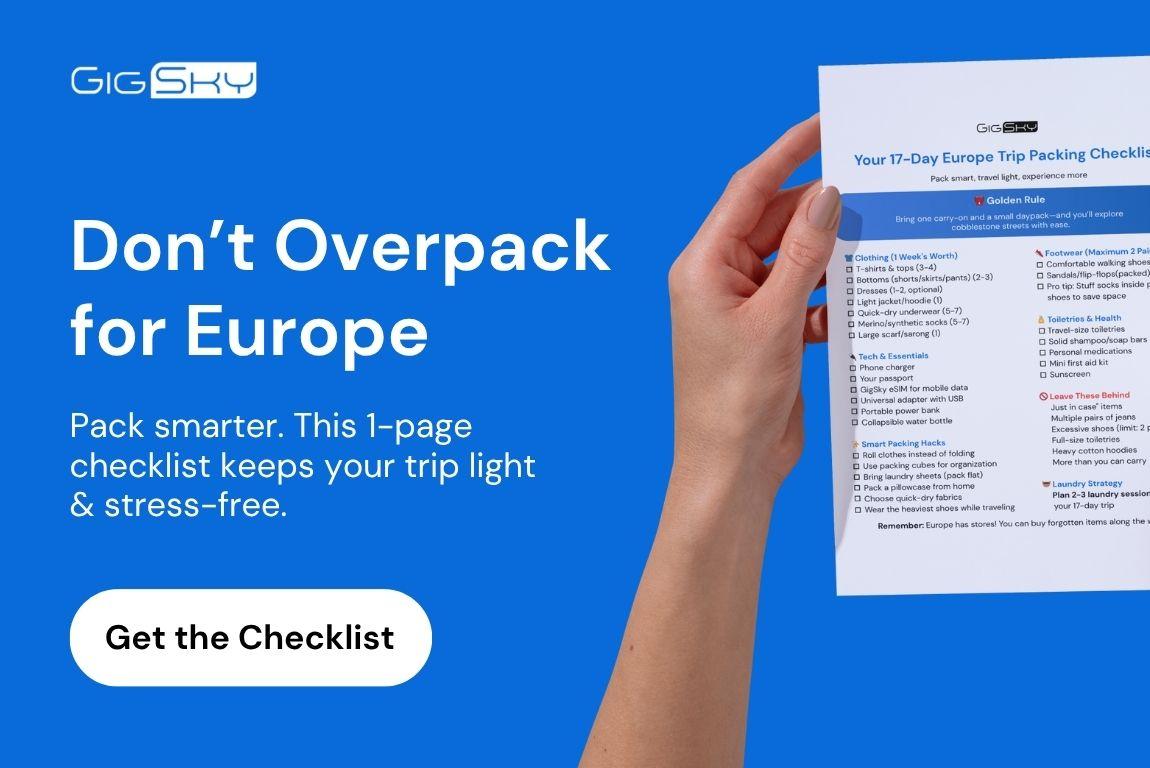
Your Complete Europe Vacation Packing List
Clothes (1 week's worth):
- 3-4 tops (mix of t-shirts and one nicer shirt)
- 2-3 bottoms (shorts, skirt, lightweight pants)
- 1-2 dresses (optional)
- 1 light jacket/hoodie
- 5-7 underwear (quick-dry)
- 5-7 socks (merino or synthetic)
- 1 large scarf/sarong
Shoes:
- 1 pair comfortable walking shoes (worn)
- 1 pair sandals/lighter shoes (packed)
Essentials:
- Your passport
- Minimal toiletries (travel-size or solid)
- Medications
- Phone charger and universal adapter
- eSIM (for mobile data in 43 European countries)
- Small first aid kit
- Collapsible water bottle
- Packing cubes
- Laundry sheets
What to Leave Behind:
- "Just in case" items
- Multiple pairs of jeans
- Excessive shoes
- Full-size toiletries
- Heavy cotton items
- More than you can comfortably carry
Adapting This Check List for a 21 Day Trip to Europe
If you're planning a longer adventure, this check list for a 21 day trip to Europe can easily be adapted.
The beauty of minimalist packing is that whether you're traveling for 17 days or extending to three weeks, the core principles remain the same.
You might consider adding one extra set of underwear and socks, but resist the urge to dramatically increase your wardrobe.
The laundry strategy becomes even more important for longer trips – plan to do laundry every 7-10 days rather than just once.
For those planning even longer European adventures, this same Europe trip packing philosophy scales beautifully.
The key is maintaining discipline and remembering that Europe has everything you need to purchase along the way.
Your Minimalist Europe Trip Packing List [Quick Recap]
- Pack One Bag, Travel Light: Use a carry-on backpack + small daypack to avoid cobblestone struggles, airline fees, and slow transit. Skip rolling suitcases entirely.
- Capsule Wardrobe Means Freedom Bring 1 week's worth of versatile, quick-dry clothing: 3–4 tops, 2–3 bottoms, 1 light jacket, 5–7 underwear/socks, 1 scarf. Choose breathable fabrics (merino, linen, synthetics); skip denim and bulky items.
- Limit Shoes to Two Pairs: Wear broken-in walking shoes, pack sandals/flip-flops. No heels. Store items inside packed shoes to save space.
- Do Laundry, Don't Overpack: Plan to do laundry 2–3 times using laundromats or sink washing. Quick-dry clothes = dry by morning.
- Avoid “Just in Case” Items: Eliminate anything not worn frequently. Choose multi-use items like a rain jacket that doubles as a coat.
- Use Smart Packing Techniques: Roll clothes, use packing cubes or mesh bags for organization. One cube for dirty laundry.
- Travel Hacks That Pay Off: Bring: scarf/sarong, eSIM (e.g., GigSky), portable charger, universal adapter, solid toiletries, mini first aid, collapsible water bottle, pillowcase.
- Mindset Shift: Packing less equals less stress, more freedom. Leave room for souvenirs and enjoy smoother, lighter travel.
- Adapt for 21+ Days: Same core list applies. Add only 1–2 more underwear/socks. Laundry becomes even more essential.