

%2520(94).jpg&w=3840&q=75)


How to Choose an eSIM for Multi-Country Travel in 2026 (Without Regretting It)
Planning a multi-country trip? Here's how you choose the right eSIM, avoid common mistakes, and stay connected across every destination.
 by Amira Bula
Choosing the wrong eSIM for a multi-country trip is an easy mistake to make, and a frustrating one to fix mid-trip.
This guide covers the three questions to ask before buying, how to read throttling thresholds, and how the top providers compare, so you can find the best eSIM for multi-country travel 2026 without second-guessing yourself at the airport.
Before you get to any of that: GigSky offers a free trial in 175 destinations, and if you hold an eligible Visa card, that trial includes up to 7 days of free unlimited data in selected destinations.
3 Questions Every Traveler Should Ask First
Don't choose the best eSIM for multi-country travel 2026 until you answer these 3 questions.
1. Which countries am I visiting?
The most common mistake is buying an eSIM for just the first stop. Say you're flying into the U.S., but your trip continues through Mexico and Canada, and you need an eSIM for the 2026 World Cup add link.
If you buy a USA-only plan, you'll be scrambling to purchase another one before each border crossing.
Several eSIM providers offer regional plans covering multiple countries under one purchase.
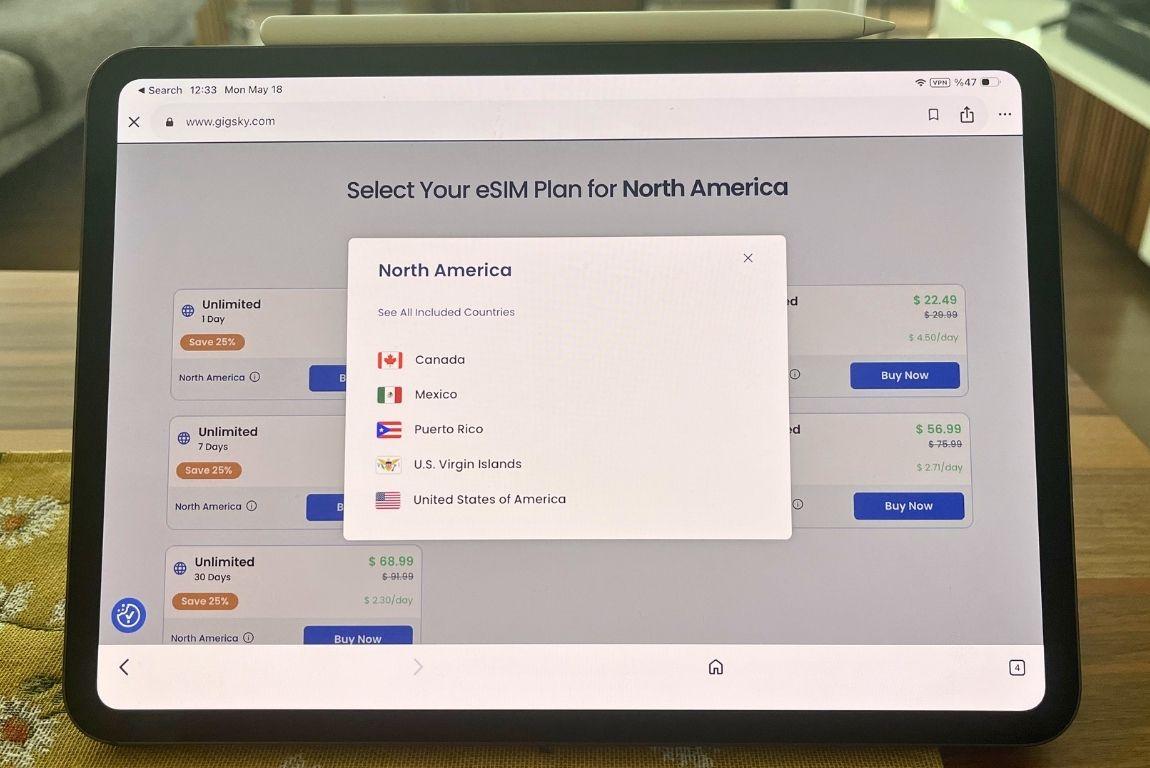
Some go further with world data plans covering 128 countries or more. Before you buy anything, count your destinations.
Then find one plan that covers all of them. You'll pay less and carry fewer eSIM profiles on your device.
2. What does 'unlimited' mean?
This one trips people up more than any other feature. Unlimited does not mean full speed from start to finish.
Every eSIM provider that offers unlimited plans has what's called a throttling threshold, and the threshold tells you how much high-speed data you get before speeds slow down.
GigSky's threshold sits at 3.5 GB per day, which resets every 24 hours. Nomad throttles at 2 GB. Airalo at 3 GB. Holafly doesn't publish their number at all.
In practice, most travelers use somewhere between 500 MB and 1 GB per day. Maps, WhatsApp, email, some social scrolling. Unless you're uploading content or on video calls for hours, you're unlikely to hit those thresholds.
But if you're a creator or working remotely on the road, the threshold matters, and you'll want to know it before you buy.
If you don't want to track your usage at all, unlimited is the right call. If you use under 500 MB daily, a fixed data plan could save you money.
3. Am I staying in one country or crossing borders?
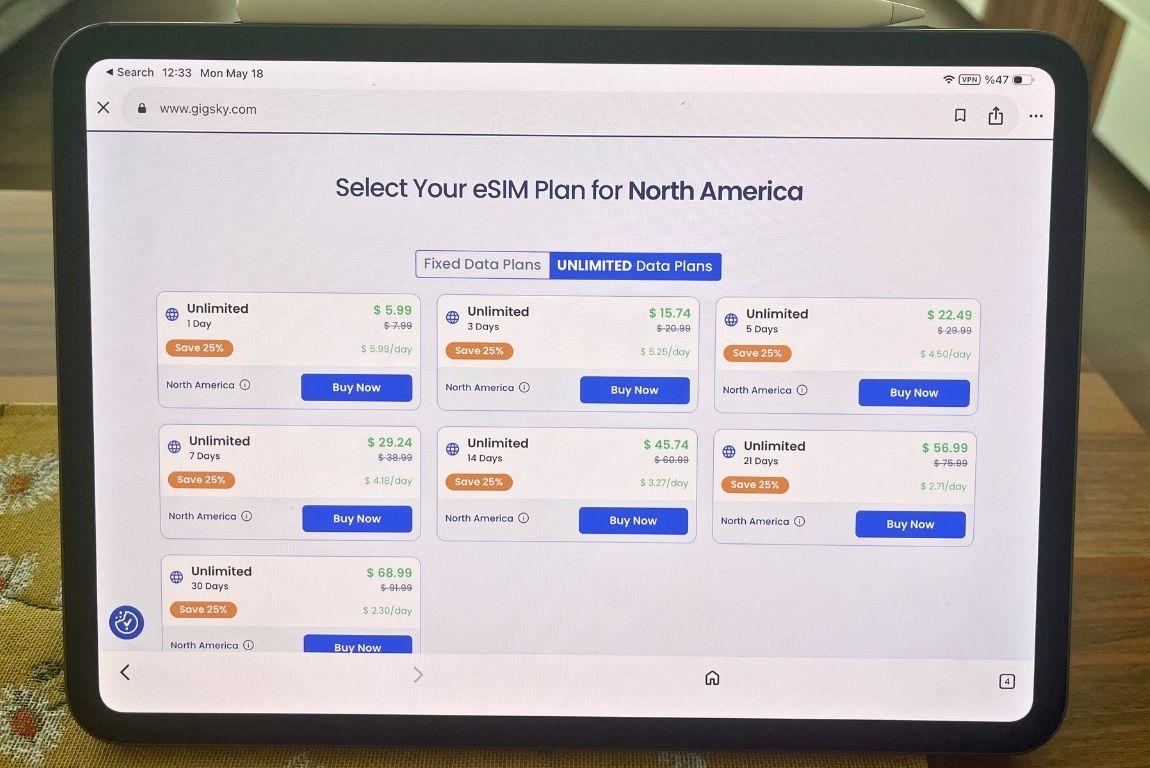
The answer changes what you need more than anything else, and it's the key factor in choosing the best eSIM for international travel. A month in the US is a completely different situation from two weeks covering Canada, Mexico and the USA.
For a long stay in one place, you'll need a higher total data allowance and may want to look at a monthly subscription option. GigSky One, for example, covers 120+ countries on a monthly plan.
For multi-country trips, the priority is seamless switching. When you cross a border, you don't want to manually configure settings or switch eSIM profiles.
The GigSky eSIM auto-connects to the strongest available local network when you arrive in a new country. Nothing to tap, nothing to configure.
Regional Plan vs. Local SIM: An Honest Comparison
There's still a case for buying a local SIM in certain situations, particularly if you need a local number for food delivery apps or similar services.
But for most people looking for the best eSIM for travel, the local SIM approach creates more friction add link
| Feature | Local SIM | Regional eSIM |
|---|---|---|
| Local number | Gives you a local number for food delivery or local services | Calls via WhatsApp or FaceTime. No local number needed for most travelers. |
| Home SIM | Must remove your home SIM. Risk of losing it while traveling. | Your home SIM stays in. Nothing to lose or swap. |
| Setup | May require ID, queuing at a kiosk, and speaking the local language. | Install before you leave home. You're connected before you pass through passport control. |
| Coverage | Only valid in one country. Crossing into different countries usually means buying another one. | Regional plans cover up to 40+ countries. One plan covers the entire trip. |
One thing worth knowing: in Europe, a SIM bought in Spain may not work in Switzerland. Cross outside that bloc and you're buying again.
With a regional eSIM plan, you check whether your destination is covered and that's the end of it.
For more on this, see why local SIMs are becoming less reliable for international travelers.
What 'Reliable Data' Means
200 countries sounds the same whether you're looking at GigSky or any other eSIM provider. What determines whether your data works on the ground comes down to a few things that aren't always obvious from the eSIM page.
Speed throttling
Already covered above, but worth reiterating. Know the threshold before you buy. A provider that won't publish their throttling policy is telling you something.
Network partnerships at your destination
This is where the difference between a mobile virtual network operator (MVNO) and a reseller shows up in real life.
GigSky operates as a mobile operator, meaning it works directly with local carriers rather than routing through a third party.
When connectivity is patchy, a mobile operator can auto-switch to a stronger carrier in the area. A reseller is locked to whatever their wholesale partner gives them.
In major cities, you'd be hard-pressed to notice the difference. In rural areas, island destinations, or anywhere off the standard tourist trail, the distinction matters.
GigSky performs well in remote areas. Other providers are more city-centric by design.
Activation problems
Two things that often get skipped before booking: checking whether your phone is eSIM-compatible, and confirming it's unlocked.
Both take about two minutes in your phone settings and can save you a lot of trouble at the airport.
Some providers email you a QR code to scan. If you mistype your email, that's a customer support ticket before your trip starts.
Some airports don't offer free Wi-Fi, or require a local number to connect, which means you need a strong connection to install the eSIM right when connectivity is hardest to come by.
The cleaner path is installing the eSIM at home, a day or two before departure. You land already connected. No airport Wi-Fi, no QR code hunt, no delay.
Comparing Top eSIM Providers: 2026 Snapshot
Choosing the best travel eSIM gets harder once your trip includes multiple countries.
Here’s how GigSky, Airalo, Holafly, and Nomad compare for travelers looking for the best eSIM for international travel.
| Feature | GigSky | Airalo | Holafly | Nomad |
|---|---|---|---|---|
| Coverage | 200+ countries, 290+ cruise ships, 100+ European ferries | 200+ countries | 200+ countries | 200+ countries |
| Pricing for Regional Plans | From $6.79 | From $6.50 | From $6.90 | From $8 |
| Throttling | Speeds reduced after 3.5 GB (resets every 24h) | Speeds reduced after 3 GB | ❌ Undisclosed | Speeds reduced after 2 GB |
| Activation | In-app or QR code. Auto-connects on arrival. No manual steps. | App, QR code, or manual entry. Must activate manually on arrival. | App or QR code. Manual activation on arrival. | QR code only. |
| Hotspot | Unlimited | Unlimited | Limited (500 MB to 1 GB/day) | Unlimited |
| Multi-country | ✅ | ✅ | ✅ | ✅ |
| Support | 24/7 chat and email | 24/7 in-app chat and email | 24/7 chat, WhatsApp, email | Tickets, email, AI bot |
A note on hotspot limits: Holafly's hotspot cap of 500 MB to 1 GB per day is worth flagging if you plan to connect a laptop or tablet through your phone.
For solo data use it's fine. For shared connectivity with a travel companion, it adds up fast.
How GigSky Addresses Connectivity Issues
Throttling after a data threshold
GigSky's threshold is 3.5 GB per day, resetting every 24 hours, the highest of any provider in this comparison, and one reason it earns its place as the best international eSIM for heavy users.
For reference, watching video at standard quality uses roughly 1 GB per hour. Most travelers, even heavy ones, don't get close to that on a normal day of sightseeing.
Activation friction
You install once through the app, or via QR code if you prefer that. No email delays. Once installed, the eSIM stays on your device and can be reused across trips.
You don't need to scan a new QR code every time you travel or manage multiple profiles for different destinations. Everything happens inside the app.
Multi-country switching
Because GigSky operates as an MVNO and partners directly with local carriers, it auto-connects to the best available network when you arrive somewhere new.
When you cross the border, your phone picks up a signal. That's it. No manual settings, no switching between profiles, no reading instructions in an airport bathroom.
Hotspot limits
GigSky plans include unlimited hotspot data. If you're traveling with someone else and want to share your connection, or you need to get your laptop online at a cafe, there's no separate cap to track.
5 Tips Before You Choose an eSIM
Before buying any eSIM for your trip, run through these five checks. They take 10 minutes and they've saved a lot of travelers from a bad first day.
- Check that your phone is unlocked and eSIM-compatible. You can confirm both in your device settings. Carrier-locked phones from certain mobile plans may need to be unlocked before an eSIM from a third party will work.
- Figure out your daily data habits. If you primarily use Google Maps, WhatsApp, and occasional email, you're likely in the 300 to 500 MB per day range. Social media scrolling adds more. Video streaming adds significantly more. Knowing this helps you pick between a fixed plan and an unlimited one without overpaying.
- Count your countries and your days. If you're searching for the best eSIM for multi-country travel 2026, regional plans are almost always cheaper than buying individual country plans one by one. Add up your full itinerary before you commit. The North America plan includes Canada, Mexico, Puerto Rico, U.S. Virgin Islands and the United States of America.
- Check whether your eSIM includes a free trial. GigSky offers between 100 MB and 500 MB free in 125 destinations, with no credit card required. If you have an eligible Visa card, you get up to 5GB of free data or up to 7 days of unlimited data, you can test the connection before spending anything. Also worth checking: eSIM for the World Cup 2026 add link, if your trip coincides with the tournament window. Check your eligibility in the GigSky app.
- If your trip includes a cruise or a ferry, verify that your eSIM covers maritime routes. GigSky is the only eSIM provider with coverage across 290+ cruise ships and 100+ European ferries. Most eSIM plans are land-only, which means you'd lose connectivity the moment the ship leaves port.
Recap: How to Choose the best eSIM for multi-country travel 2026
- Count every country on your itinerary before buying. A regional plan covers all of them for less than individual plans per stop.
- Unlimited doesn't mean uncapped speed. GigSky's 3.5 GB daily threshold is the highest in this comparison. Nomad throttles at 2 GB, Airalo at 3 GB, Holafly doesn't disclose their limit.
- GigSky operates as an MVNO, not a reseller. That means direct carrier partnerships, auto-connection on arrival, and better performance in areas outside major cities.
- After you choose, install your eSIM at home before you leave. No airport Wi-Fi needed, no QR code delays, no problems passing through passport control before you're connected.
- If your trip includes a cruise, GigSky is currently the only eSIM provider covering both land destinations and ships.
- Check your eligibility for a free eSIM trial. GigSky offers free data in 175 destinations, from 100 MB to 5 GB, no payment required to start.
Check coverage for your destinations at gigsky.com, or download the GigSky app to see if you're eligible for a free trial before your trip.